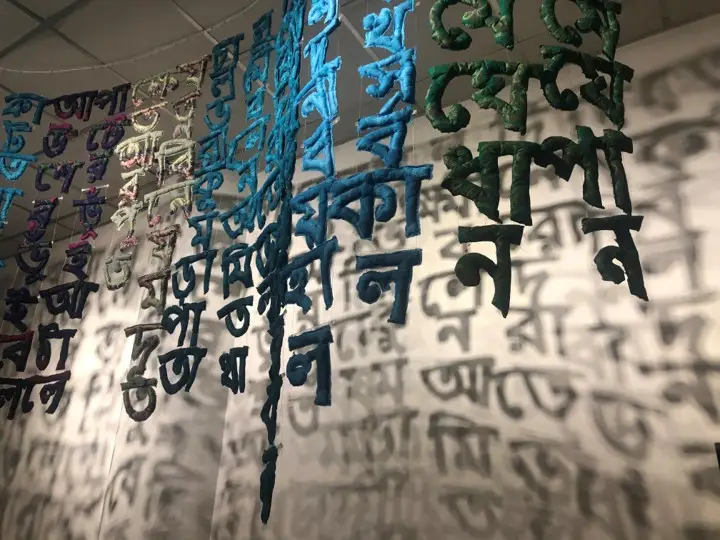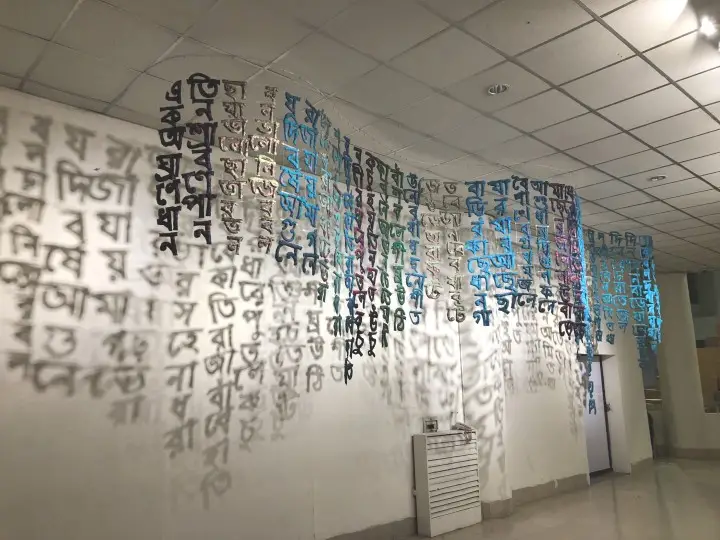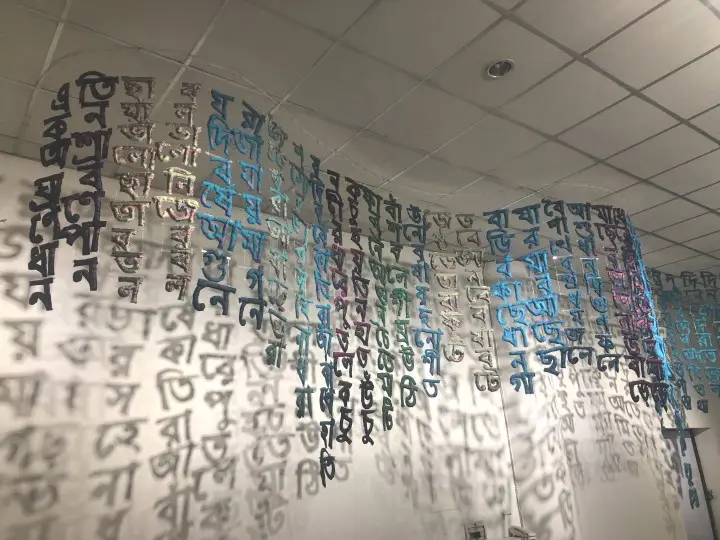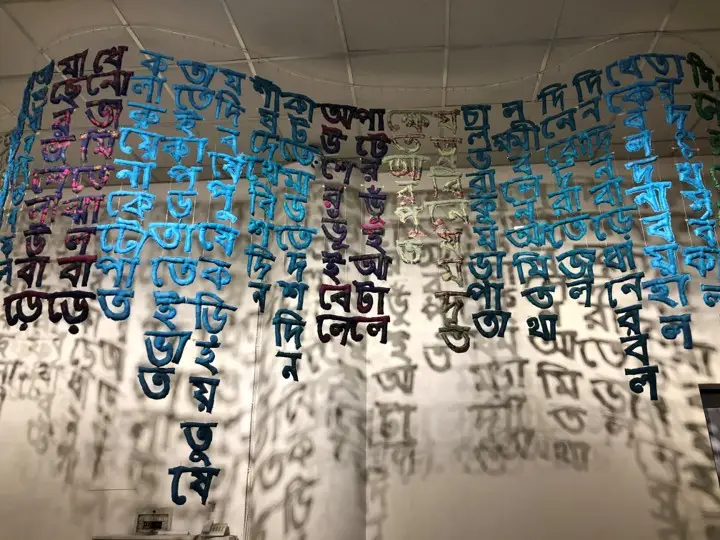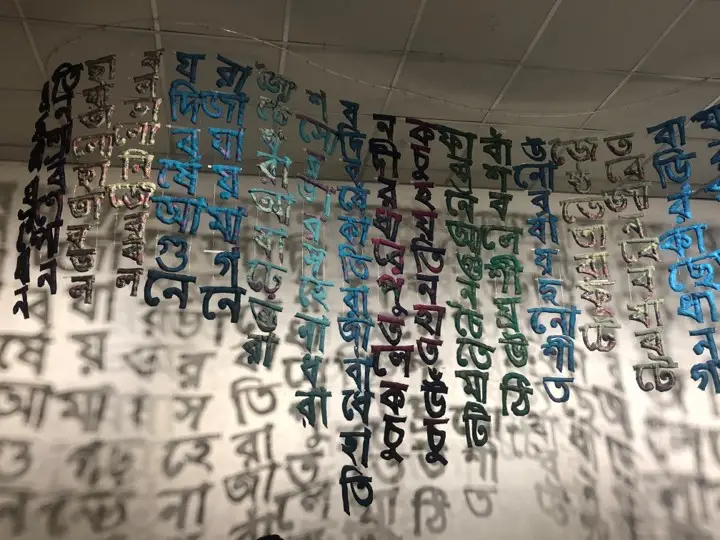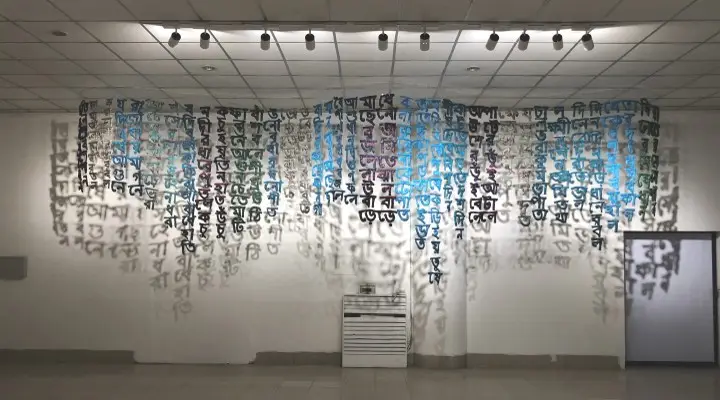
Symphony of Worlds
Tangail Sari(tradition handloom cotton sari from Tangail region, my home town).Cotton, Thread.
Dimension – Variable
Bengali script seems to drip from the ceiling as rain, or flow through space like a river, similar to how the words of Khana have flowed across time in Bangladesh. Khana was a poet and an astrologer active in Bengal somewhere between the 9th and 12th centuries, and her verses are among the earliest compositions of lyrical Bengali verse and tied to wisdom gleaned from observing nature. According to legend, Khana attracted the attention of King Vikramaditya by solving problems that neither her husband nor her father-in-law, who were both court astronomers, could answer. Threatened by her knowledge and divinatory power, her father-in-law had her tongue cut off and forced her into exile. In another version, Khana cut off her own tongue to spare her father-in-law the shame of being upstaged by a woman. Both scenarios speak to how the fragility of male egos threatens the basic wellbeing of women.
Putting Khana’s words into the air as sayings and/or writing them into physical form as text, or inscribing them as an artwork as the artist Najmun Nahar Keya has, speaks to the power of orality and of collective memory to keep alive the wisdom that oppressive forces, such as patriarchy, have tried in vain to silence. These sayings that are still alive in rural Bangladesh today, known as Khanar Bachan (Khana’s words), are also a collective memory of climate, and how human behavior and weather could interact to produce fruitful results. These adages must have worked at some point; otherwise it is unlikely that they would have been carried across so many generations, but they don’t all make sense anymore as weather does not move over the lands in the same way it once did. Like the Tangail sarees that Keya and her elder sisters used to craft these sayings into soft sculptural form, they are likely to become obsolete as these generationally passed down wisdoms are at risk of being forgotten.